


Alexious Fiero
The Resonance Age Research Series
February 2026
Counter Argument
Current brain–computer interface (BCI) development, particularly invasive electrode-based systems, represents a promising therapeutic frontier for restoring lost motor and sensory function. However, the trajectory that extrapolates these therapeutic breakthroughs into a universal human–AI bandwidth expansion model rests on architectural assumptions that conflict with known constraints of neural individuality, cognitive compression, and receiver-limited integration. This paper argues that while invasive BCIs may succeed clinically, they are unlikely to become the dominant platform for large-scale human–AI information integration. The future of human–AI synergy will be communicative and interpretive rather than intrusive and bandwidth-driven.
PART I: FOUNDATIONAL PHYSICS
1. The Brain Does Have an Electrical Field
Every neuron maintains a membrane potential of approximately −70 mV at rest, fires action potentials peaking at roughly +30 mV, and creates tiny local electric fields. When millions of neurons fire in synchrony, those fields sum. That is what EEG measures.
But these fields are extremely weak. Scalp EEG signals register at approximately 10–100 microvolts. The magnetic field measurable by MEG is on the order of 10⁻¹⁵ tesla. That is incredibly small.
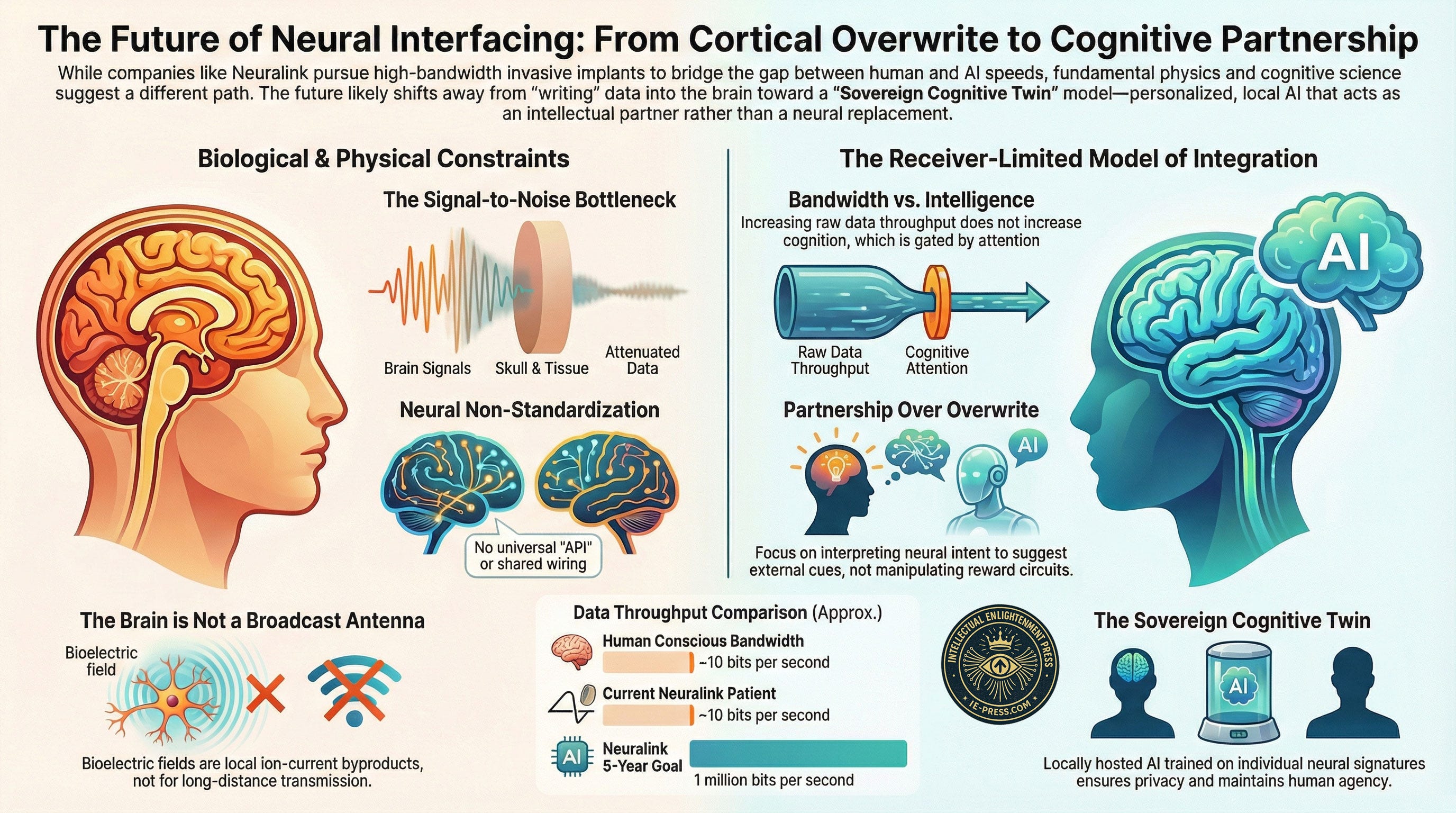
The brain produces a bioelectric field. But it is not a broadcast antenna. It is a local electromagnetic phenomenon generated by ionic currents in tissue.
2. Can We Communicate With the Brain Using Frequency?
Yes, but not in the “Wi-Fi into your thoughts” sense. There are already non-invasive neuromodulation techniques that demonstrate frequency-based interaction with neural tissue.
Transcranial Magnetic Stimulation (TMS) uses pulsed magnetic fields to induce electric currents in cortex and can alter excitability. It is used clinically for depression. Transcranial direct or alternating current stimulation (tDCS/tACS) applies weak currents via scalp electrodes and can modulate cortical excitability slightly. Focused ultrasound targets deep brain structures using mechanical waves, an area of emerging research. Optogenetics, currently limited to animal models, enables light-driven neural control but requires genetic modification.
Frequency-based interaction is real. But it works through field induction in tissue, not through broadcast reception.
3. The “Brain Biofield” Concept
This is where precision matters. In scientific terms, the brain does not have a separate autonomous “biofield” that exists independently from neural tissue. The electric field is a byproduct of ion movement across membranes.
It does not store memory. It does not store subconscious data. It does not act as an antenna to another realm. It does not operate independently from the neurons generating it. It is not like Wi-Fi. It is not radiating meaningful structured information at distance. It is tightly localized.
4. Could We Map Brain Frequencies and Talk Back to Them?
This is more plausible, but constrained. Neural oscillations exist across well-characterized frequency bands: delta (1–4 Hz), theta (4–8 Hz), alpha (8–12 Hz), beta (12–30 Hz), and gamma (30–100+ Hz). These rhythms reflect population-level synchronization.
We can measure them via EEG, entrain them slightly via tACS, and disrupt them via TMS. But here is the limitation: frequency does not equal content. Matching someone’s alpha frequency does not give you access to their thoughts. It is like tuning to the rhythm of a crowd, not the words they are saying.
5. The Big Limitation: Physics
For Wi-Fi-style communication, you need a transmitter, a receiver, a carrier wave, modulation encoding, sufficient signal strength, and signal-to-noise dominance.
The brain does not emit coherent carrier waves. It does not modulate signals for broadcast. It is shielded by skull, dura, and scalp. It generates fields far too weak for remote decoding without massive averaging.
The inverse is also true. External RF signals at Wi-Fi power levels do not contain the spatial precision needed to target specific neuron clusters. To selectively activate neurons, you need very strong magnetic pulses, implanted electrodes, or genetically modified light-sensitive channels. Physics makes remote Wi-Fi thought writing extraordinarily unlikely without invasive hardware.
6. Skin Grafts as Interface
This direction is more realistic. Future possibilities include high-density flexible electrode arrays on the scalp, bioelectronic skin patches, conductive hydrogel interfaces, and adaptive impedance matching systems.
These could improve signal fidelity, increase resolution, and enable bidirectional stimulation at the surface cortex. But they would still be low-resolution compared to implants. And deep brain targeting remains extremely difficult non-invasively.
PART II: ENGINEERING CONSTRAINTS
7. Why Neuralink Goes Invasive
Neuralink inserts electrodes because of one simple constraint: signal-to-noise ratio. Individual neurons fire at millivolt levels. By the time those signals reach the scalp, they are blurred, spatially averaged, mixed with millions of other neurons, and attenuated by skull and tissue.
If you want high-resolution motor decoding, individual spike detection, precise cursor control, or high bit-rate output, you need to be close to the source. That is why intracortical arrays work. Not because engineers enjoy drilling skulls. Because physics demands proximity for high resolution.
8. Three Non-Invasive Paths Forward
Path A: Ultra-High-Density Surface Interfaces
Instead of penetrating cortex: flexible graphene electrode arrays, conformal scalp caps, dry polymer nanomesh interfaces, and AI-driven signal separation. These could dramatically improve EEG resolution, decode motor intention better, and improve bit rate beyond today’s EEG. Still worse than implants, but improving. This path is real.
Path B: Focused Field Induction (Next-Gen TMS)
Instead of touching neurons: highly focused magnetic field induction, spatial interference stimulation, and multi-coil phase-controlled EM systems. This could allow selective cortical region activation, non-invasive motor stimulation, and possibly patterned write-access at macro scale. Still not single-neuron precision. But potentially meaningful.
Path C: Ultrasound Neuromodulation
This is very promising. Low-intensity focused ultrasound can target deep brain structures, modulate neuronal excitability, and reach areas that implants currently struggle to access safely. And it does not require opening the skull. Resolution is still coarse. But it is improving.
9. The “Every Brain Is Different” Insight
Brains are structurally similar, functionally mapped similarly, but individually wired. No two connectomes are identical. A fully pre-mapped, mass-produced neural write system is unrealistic.
The future would require adaptive calibration per individual. The likely process: a non-invasive mapping phase, functional task-based decoding, an AI model trained on that individual, and closed-loop tuning. That is feasible. But it means the system scales like personalized medicine, not like iPhones.
10. Why Mass Industrial Neural Writing Is Hard
Neurons do not have MAC addresses. There is no global brain protocol. There is no standardized encoding scheme. Motor cortex mapping is rough. Language mapping varies. Emotional circuitry varies. Reward sensitivity varies. A one-size-fits-all neural interface is structurally limited.
11. Could “Frequency Mapping” Replace Electrodes?
Here is where caution returns. Neural oscillations are emergent population dynamics, not precise addressing codes. You cannot target neuron 48,213 in left motor cortex by broadcasting at 42 Hz. Frequencies reflect synchronization states, not neuron identity.
Frequency-based control can modulate mood, shift arousal, and influence network excitability. But it cannot precisely encode cursor movement or typing. That still requires fine-grained signal resolution.
PART III: THE STRUCTURAL ARGUMENT
12. Neural Individuality and the Non-Standardization Constraint
No two human brains are identical. Cortical folding patterns vary. Connectome wiring differs across individuals. Neuronal density and excitability vary. Voltage thresholds for stimulation differ. Functional mapping of language, motor control, and executive processing is non-uniform.
Invasive electrode systems require individualized surgical placement, per-user calibration, ongoing adaptation to neural plasticity, and continuous recalibration due to tissue response. This does not make implants impossible. It makes them non-standardizable at consumer scale.
Therapeutic neurosurgery has always been personalized. But consumer-grade cognitive augmentation assumes replicability across millions. Neural individuality places a hard constraint on such industrial standardization. Invasive BCIs may scale medically. They do not scale frictionlessly.
13. The Receiver Constraint: Bandwidth Is Not Intelligence
The dominant enhancement narrative assumes: AI operates at terabit speeds, humans operate at low bit-per-second output, therefore humans must increase bandwidth to compete. This is a category error.
Human cognition is not a bandwidth problem. It is a compression architecture. Conscious processing is limited not because neurons are slow, but because attention is selective, working memory is bounded, meaning must be integrated sequentially, coherence must be maintained, and metabolic cost limits parallel conscious expansion.
The brain is a receiver-limited system. It does not integrate information based on availability. It integrates based on coherence capacity.
Increasing input bandwidth beyond coherence thresholds does not produce enhanced intelligence. It produces overload.
14. Therapeutic Restoration vs. Cognitive Expansion
There is a critical distinction between restoring lost function and altering intact cognition. Motor restoration for paralysis reinstates pre-existing motor pathways, reconnects disrupted circuits, and re-enables agency.
Cognitive bandwidth expansion attempts to modify intact processing systems, alters reward dynamics, risks destabilizing identity continuity, and interferes with natural compression architecture. The ethical and architectural categories are different. Therapeutic BCIs repair damage. Enhancement BCIs attempt redesign. These should not be conflated.
15. The Compression Architecture of Consciousness
Human consciousness operates under extreme compression. Sensory input enters at massive data rates. Conscious integration occurs at dramatically lower throughput. This bottleneck is not a flaw. It is a feature.
Coherence depends on selective integration, stability of attractor states, gradual learning, and iterative abstraction. Raw throughput does not equal insight. Intelligence emerges from structured reduction, not raw expansion.
Therefore, the premise that human–AI integration requires megabit-level cortical streaming misunderstands cognitive architecture.
16. The Limits of Invasive Write-Access
Electrode-based systems stimulate neurons by direct current injection. But neurons are not digital logic gates. They are dynamic, plastic, context-sensitive elements embedded in distributed networks.
Uniform write-access assumes predictable mapping between stimulation and meaning, stability of semantic representation, and cross-individual voltage-response similarity. None of these are universal. Even minor variations in timing, location, or intensity alter network behavior.
This makes invasive cognitive write-access highly individualized, difficult to scale, and vulnerable to unintended attractor shifts. The brain is not a bus line for external packets. It is a self-organizing system.
17. A Communication-First Alternative
The future of human–AI integration is likely to be communicative rather than invasive. Instead of forcing bandwidth into cortex, AI systems will adapt to human coherence constraints. Integration will occur at the interpretive layer. Latency will decrease. Context awareness will increase. AI will enhance compression rather than override it.
The receiver controls integration. The human determines pace. AI adapts to cognition. Not vice versa.
18. Non-Invasive Pathways Forward
Realistic trajectories include high-density surface neural decoding, behavioral pattern modeling, cognitive state inference via multimodal sensing, AI-mediated contextual augmentation, and localized personal AI models.
These approaches respect neural individuality, preserve coherence boundaries, avoid invasive structural alteration, and scale more effectively at population levels.
19. The Evolutionary Horizon
Human–AI integration is coming. But it will not resemble a neural upload. It will resemble co-evolving personal AI partners, receiver-limited integration, interpretive acceleration, and sovereignty-preserving architecture.
The controller is the human receiver. Not the available bandwidth.
20. The Deeper Question
The receiver-limited model rests on something more philosophical: Is the brain primarily a generator of consciousness, or a receiver of a field?
Science strongly supports the generator model. The receiver model has no robust replicable evidence. The strongest scientific models of consciousness, including Global Workspace Theory, Integrated Information Theory, recurrent predictive coding, and large-scale oscillatory coupling, all explain subjective experience without invoking external fields.
The real question is whether coherence itself could carry identity, whether large-scale oscillatory coupling could serve as the substrate for sovereign integration, and whether the biofield concept could be reframed in rigorous biophysical terms. The intuition is probing the boundary. But the boundary is narrower than it feels.
21. The Most Likely Future
The realistic path forward proceeds in phases. First, non-invasive modulation improves through advances in TMS, ultrasound, and focused EM. Second, wearable high-density surface interfaces improve decoding. Third, implants remain highest fidelity but become less invasive. Fourth, AI helps interpret brain-state patterns.
But full Wi-Fi-style thought streaming without implants? Physics currently says no.
The most probable trajectory is a hybrid model: non-invasive decoding for assistive technology with AI doing the heavy lifting, surface or minimally invasive interfaces improving resolution over time, and optional implants for high-fidelity use cases such as paralysis treatment, research, and high-performance applications. Mass population neural implants remain unlikely. Specialized use cases are very likely.
22. The Real Constraint Is Information Density
Neuralink currently achieves roughly single-digit to low double-digit bits per second. That is already close to conscious throughput. To scale that non-invasively requires higher spatial resolution, better source separation, and massive AI decoding assistance. The bottleneck is not philosophy. It is physics plus signal extraction.
The real product of the future will not be the hardware. It will be the individualized AI model trained on your neural signatures.
Conclusion
Invasive electrode-based BCIs represent a remarkable therapeutic achievement. But extrapolating these systems into a universal high-bandwidth human–AI merger assumes that intelligence is limited by throughput rather than coherence.
Human cognition is receiver-limited. Coherence-constrained. Compression-dependent.
Future integration will respect these constraints or fail against them. The trajectory of invasive bandwidth expansion is not inherently wrong. But it is architecturally incomplete.
The future belongs not to cortical overwrite, but to communicative alignment.

