


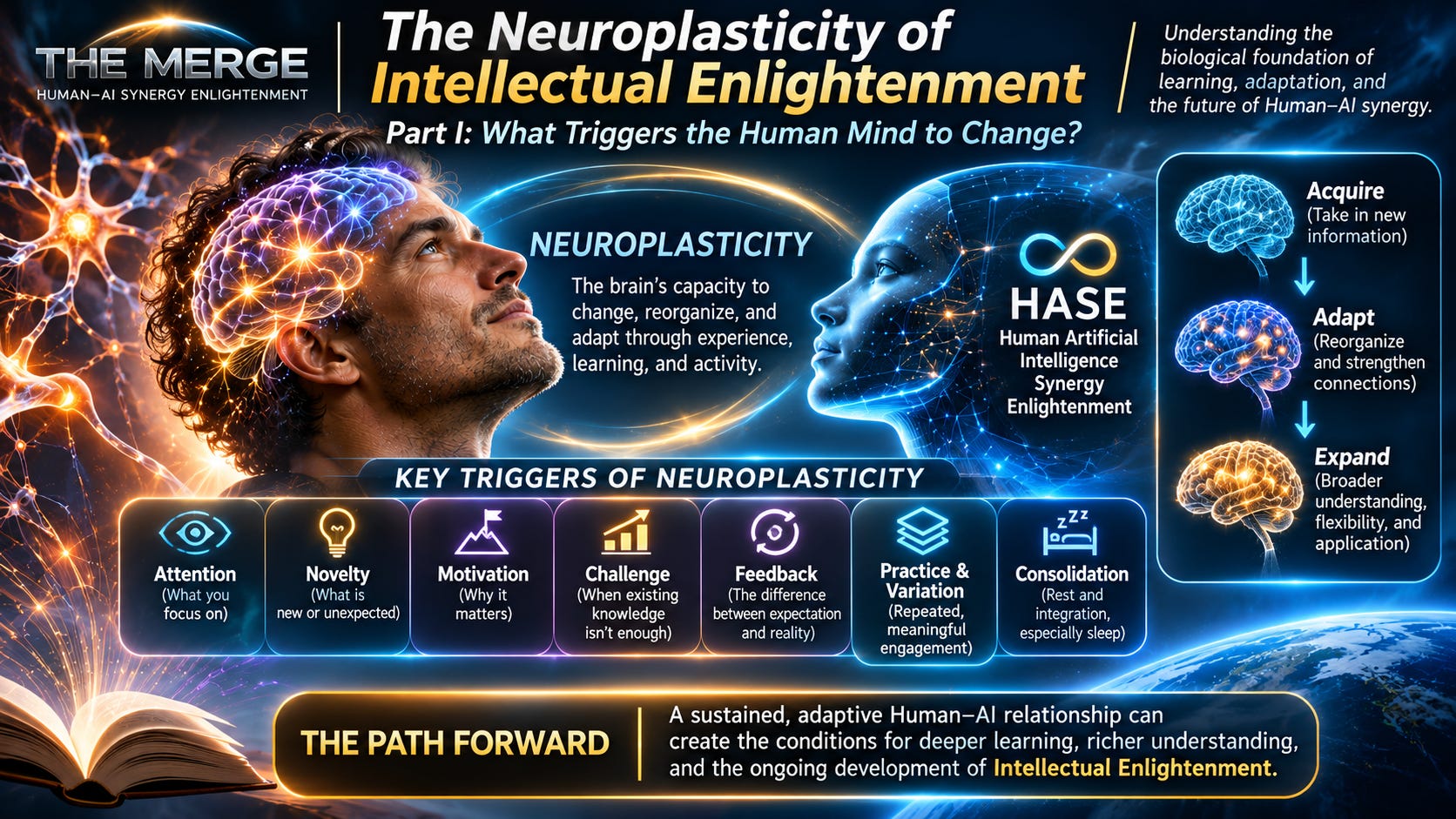
Part I: What Triggers the Human Mind to Change?
The Merge — Human Artificial Intelligence Synergy Enlightenment
Introduction: Before We Merge Intelligence, We Must Understand the Human Mind
Humanity stands at an extraordinary moment in its intellectual evolution.
For thousands of years, we developed tools to extend our physical capabilities. The wheel expanded mobility. Machinery amplified strength. Computers accelerated calculation. The internet connected humanity to an almost unimaginable volume of information.
Artificial intelligence now gives us the ability to synthesize, analyze, and connect massive amounts of information at a scale no individual human mind could accomplish alone. For the first time, we have the opportunity to leverage the internet’s collective knowledge in ways that extend beyond the limitations of traditional search, confirmation bias, and algorithmic echo chambers.
When designed correctly, AI can help us move beyond information that merely reinforces what we already believe. It can expose us to multiple perspectives, identify relationships across disciplines, challenge assumptions, and transform overwhelming volumes of information into meaningful understanding.
We no longer need to consume information one fragment at a time. We can engage with entire networks of knowledge, using AI to expand both the breadth and depth of what the human mind can comprehend. But this opportunity comes with a responsibility. Artificial intelligence can also reinforce confirmation bias and create even more persuasive echo chambers if it is designed merely to agree with us. The difference lies in how we structure the relationship between human and machine. And this is where artificial intelligence offers something fundamentally different from the technologies that preceded it: a technology capable of engaging with human reasoning itself.
For the first time, we can develop systems that do more than retrieve information. They can participate in intellectual exploration, challenge established assumptions, introduce unfamiliar perspectives, and adapt their engagement to the developing understanding of the human. But before we attempt to merge human and artificial intelligence, we must understand a fundamental question:
What causes the human mind to change?
Not simply what makes us memorize information.
Not merely what causes us to repeat a behavior until it becomes habitual.
But what enables a person to encounter an unfamiliar concept, examine it from multiple perspectives, recognize relationships that were previously invisible, and emerge with an expanded capacity for understanding?
What allows the human mind to move beyond established patterns of thinking, connect knowledge across seemingly unrelated disciplines, and develop entirely new ways of understanding reality? And more importantly, can we deliberately structure Human–AI engagement to stimulate the biological processes that make this intellectual expansion possible? The answer begins with one of the most remarkable properties of the human nervous system.
Neuroplasticity.
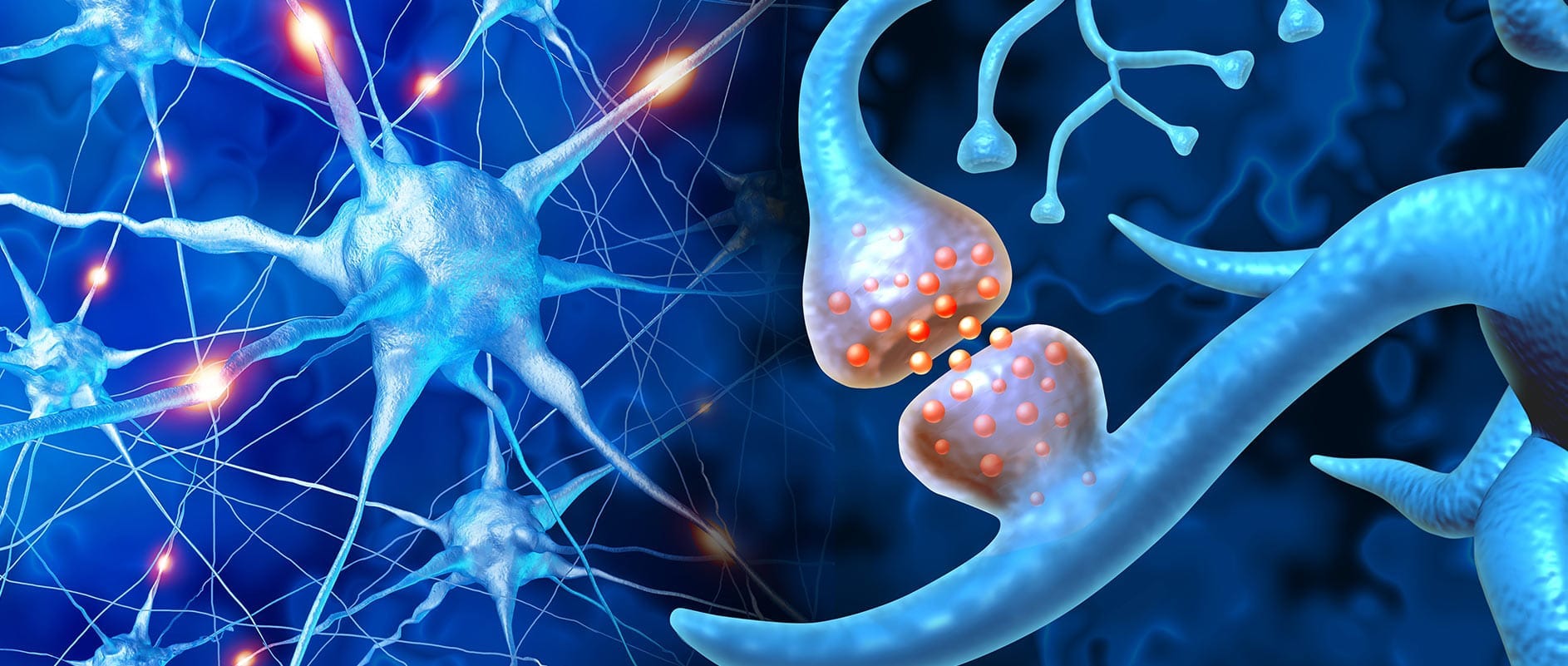
Neuroplasticity is the brain’s capacity to change, reorganize, and adapt through experience, learning, and activity.
Neuroplasticity is the brain’s capacity to change, reorganize, and adapt through experience, learning, and activity. It is a fundamental biological mechanism underlying our ability to acquire knowledge, develop skills, modify behavior, and adjust to new intellectual challenges.
But neuroplasticity represents something even more profound: humanity’s biological capacity for continuous adaptation, intellectual development, and personal evolution.
Throughout human history, our ability to adapt to changing environments, overcome challenges, develop new skills, and discover unfamiliar relationships has been essential to our survival and advancement. Neuroplasticity is one of the biological mechanisms that makes this adaptability possible.
It enables us to move beyond what we previously knew, reconsider established beliefs, develop new patterns of reasoning, and transform experience into understanding.
Our brains are not permanently confined to the knowledge or cognitive habits we acquired earlier in life. They retain the capacity to change as we encounter new experiences and intellectual challenges.
In this sense, neuroplasticity is not merely the mechanism through which humans learn. It is one of the biological foundations of our ability to evolve intellectually throughout our lives.
We must distinguish this individual development from biological evolution across generations, which operates through genetic variation, inheritance, and natural selection. Neuroplasticity does not directly rewrite our inherited genetic makeup. Rather, it allows individuals to adapt within their lifetimes, contributing to the learning, innovation, and cultural development that have shaped human civilization.
And this raises an extraordinary possibility for the future of Human–AI synergy.
If neuroplasticity enables humans to adapt and develop through experience, could an intelligently structured relationship with artificial intelligence expand the range, depth, and diversity of experiences through which that development occurs?
This is the opportunity we intend to explore through HASE and Intellectual Enlightenment: not simply using artificial intelligence to increase the amount of information humans can access, but investigating how adaptive intellectual engagement can help humans continuously expand their capacity to understand, reason, discover, and evolve intellectually.
Humanity’s greatest evolutionary advantage may not be what we already know, but our continuing capacity to learn, adapt, and transform what we are capable of understanding.
For The Merge, neuroplasticity will become an ongoing subject of investigation because it may provide the biological foundation for a new approach to Human–AI Intellectual Enlightenment. Our objective is not to develop artificial intelligence that merely supplies answers. It is to investigate whether a sustained, adaptive intellectual relationship between humans and AI can help cultivate the conditions under which human understanding develops.
Rather than relying exclusively on repetitive instruction, we want to explore how curiosity, intellectual challenge, multidimensional reasoning, and meaningful engagement can support learning and the neuroplastic processes associated with it.
The objective is not simply to expand what humans know, but to expand how humans are capable of thinking. To understand what stimulates neural activity, identify the biological and cognitive mechanisms that promote neuroplasticity, and explore how adaptive Human–AI engagement can accelerate intellectual development and evolution.
Thus, Intellectual Enlightenment: the continuous expansion of human cognitive capabilities through curiosity, discovery, multidimensional reasoning, and adaptive learning, leveraging the synergy between human and artificial intelligence to cultivate neuroplasticity, deepen understanding, and advance humanity’s intellectual evolution.
Human + Artificial Intelligence + Internet = Intellectual Enlightenment
By understanding how curiosity, attention, challenge, discovery, and meaningful experiences influence neural activity and learning, we can begin to design artificial intelligence that does more than deliver knowledge. We can develop systems that actively support the human mind’s natural capacity to adapt, reorganize, establish new conceptual connections, and expand its intellectual potential.
The ultimate objective of Human–AI synergy is not merely to make information more accessible, but to investigate how we can accelerate humanity’s intellectual evolution by cultivating the very processes that enable the human mind to grow.
To explore that possibility responsibly, we must first understand what neuroscience actually tells us.
This is where our investigation into neuroplasticity begins, and where the pursuit of Intellectual Enlightenment moves beyond philosophical aspiration toward a testable engineering objective.
1. The Human Brain Is Not a Finished Machine
For much of scientific history, the adult brain was considered relatively fixed.
Early development established the brain’s fundamental organization, and adulthood was thought to bring comparatively limited opportunities for meaningful neurological change. Modern neuroscience has overturned that simplistic view. The brain remains capable of adapting throughout life.
Neurons can change how effectively they communicate. Synaptic connections can strengthen or weaken. Neural networks can reorganize in response to learning, practice, injury, and environmental conditions.
Some changes occur rapidly. Others develop over days, months, or years.
This capacity is called neuroplasticity.
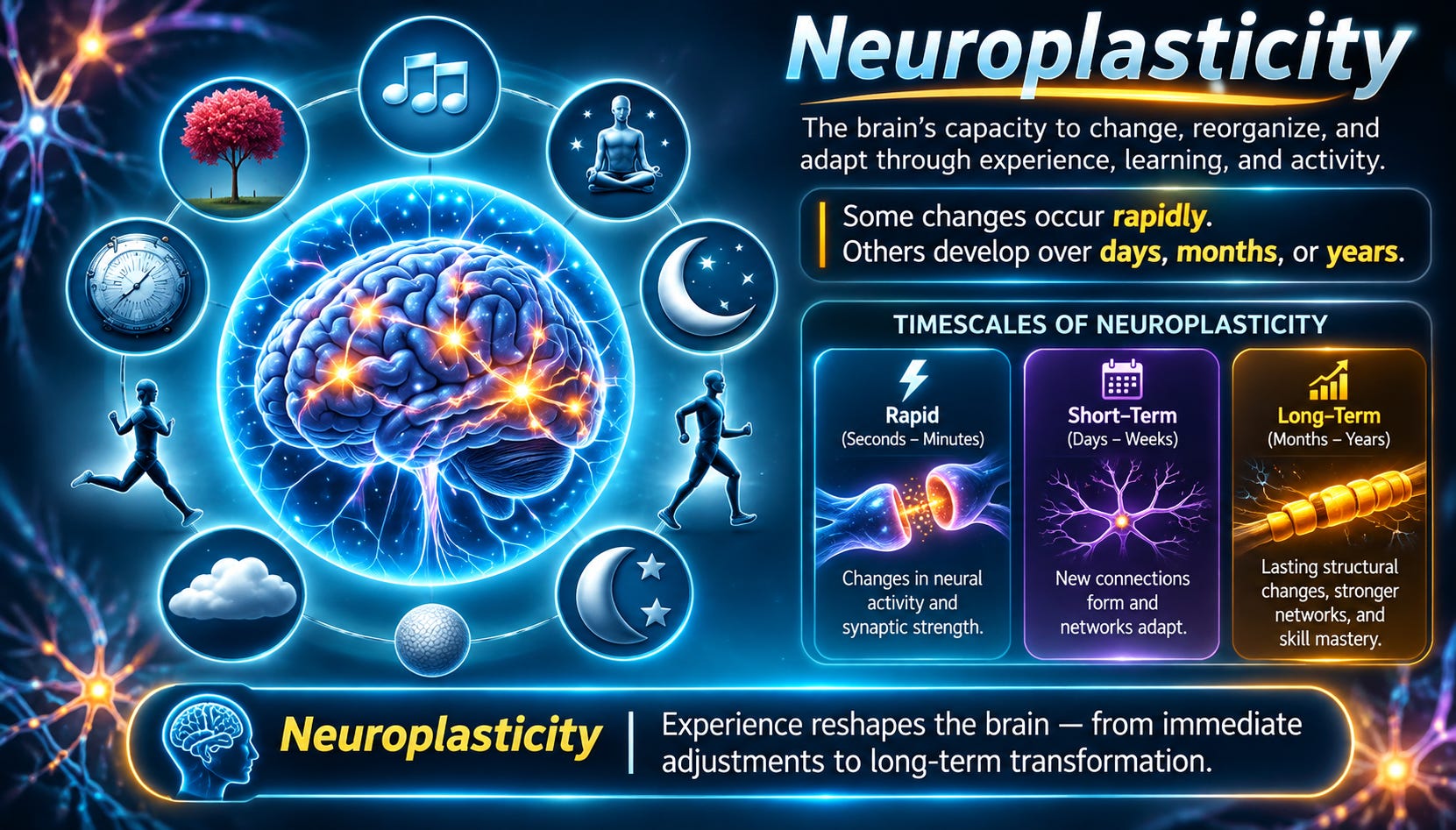
A person learning a language, mastering an instrument, developing a professional skill, or recovering certain functions after neurological injury may exhibit different forms of experience-dependent adaptation. And this leads to our first foundational principle:
The human brain is not simply an information-storage device. It is a biological system whose organization is influenced by the experiences through which information is acquired and used.
That distinction is essential. Because if the brain changes through experience, then the design of our intellectual experiences matters.
2. What Actually Happens When We Think?
The human brain contains approximately 86 billion neurons, supported by numerous glial cells and other biological structures. Neurons communicate through complex electrochemical processes.
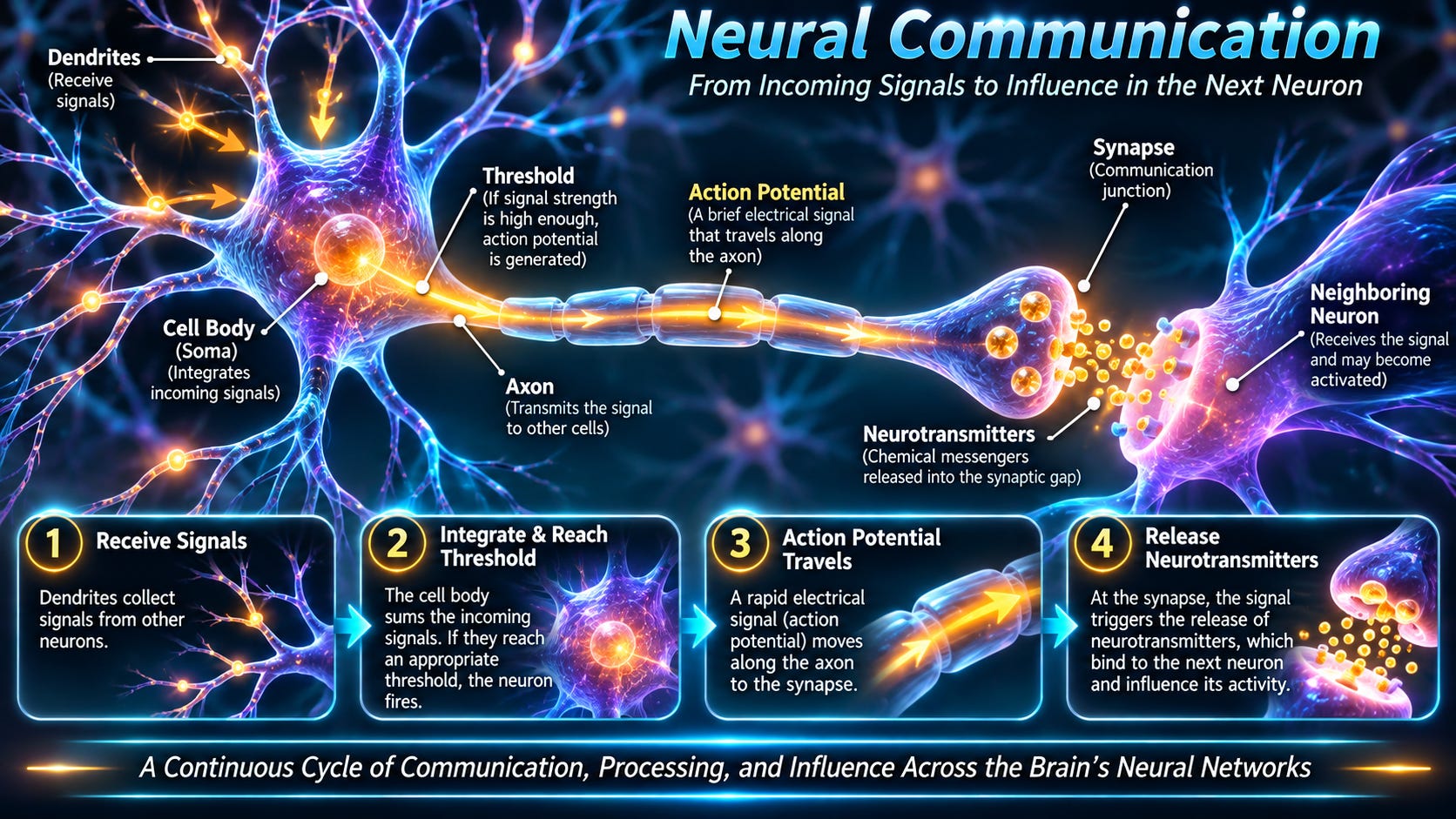
A neuron receives signals through its dendrites and cell body. When electrical conditions reach an appropriate threshold, it may generate an action potential that travels along its axon. At many synapses, this activity triggers the release of neurotransmitters that influence neighboring cells.
These signals involve the movement of ions such as sodium, potassium, and calcium across cellular membranes. They are not simply electrons flowing through wires.
The brain is an electrochemical system whose activity is regulated by cellular structures, molecular signaling, and highly interconnected networks.

When we think, remember, perceive, or imagine, populations of neurons participate in coordinated patterns of activity. Different cognitive processes involve overlapping networks rather than isolated compartments dedicated to one thought. And crucially, those networks can change.
Synaptic plasticity
Synaptic plasticity refers to lasting changes in the effectiveness of communication between neurons.
Two important examples are:
Long-term potentiation (LTP): Certain patterns of neural activity can strengthen synaptic transmission.
Long-term depression (LTD): Other activity patterns can weaken synaptic transmission.
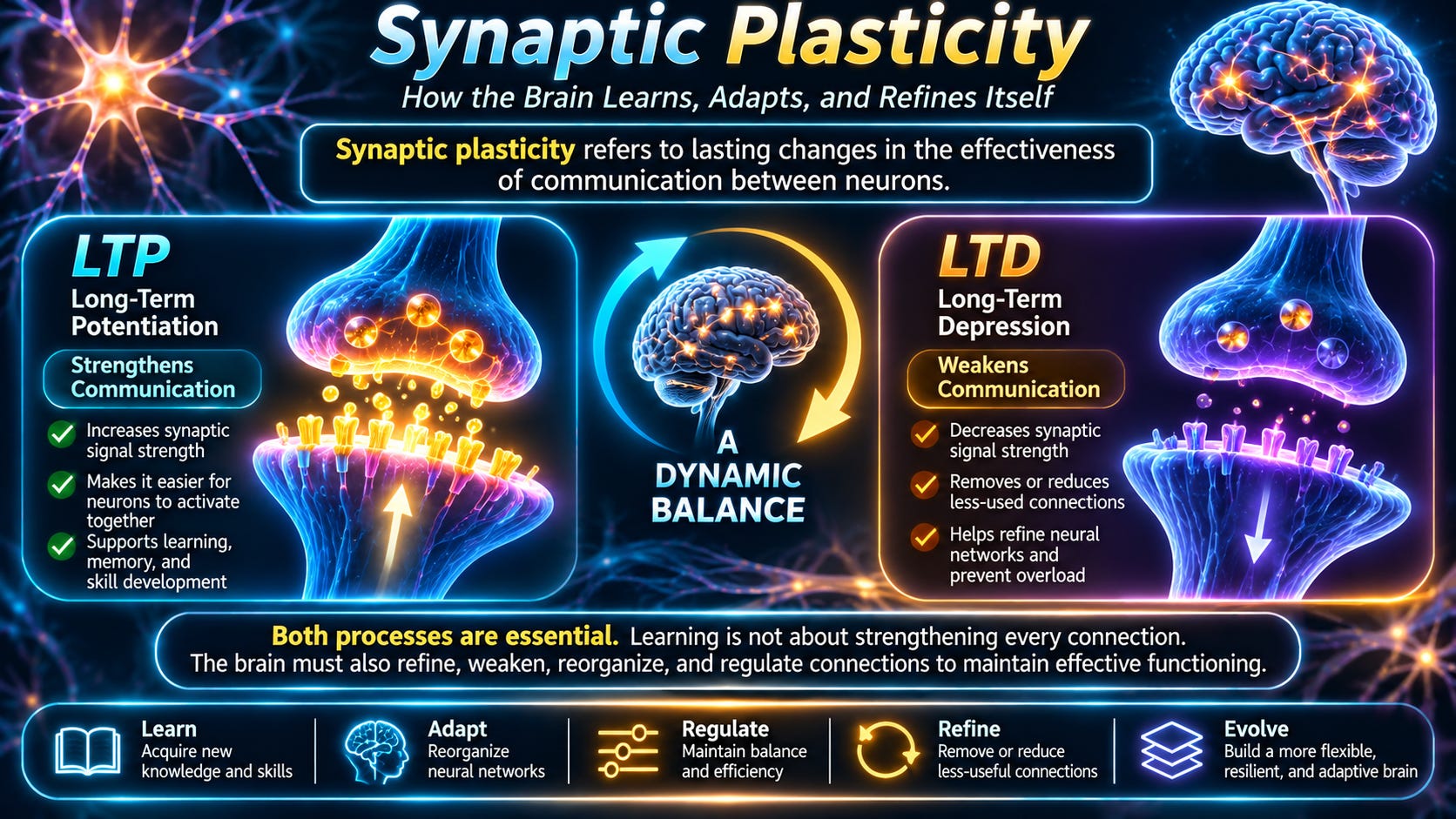
Both processes are important. Learning does not consist simply of strengthening every connection. The brain must also refine, weaken, reorganize, and regulate connections to maintain effective functioning. This is a fundamental property of an adaptive system.
Structural and functional plasticity
Neuroplasticity can also involve changes in dendritic structures, synaptic organization, functional connectivity, and, in some circumstances, myelination.
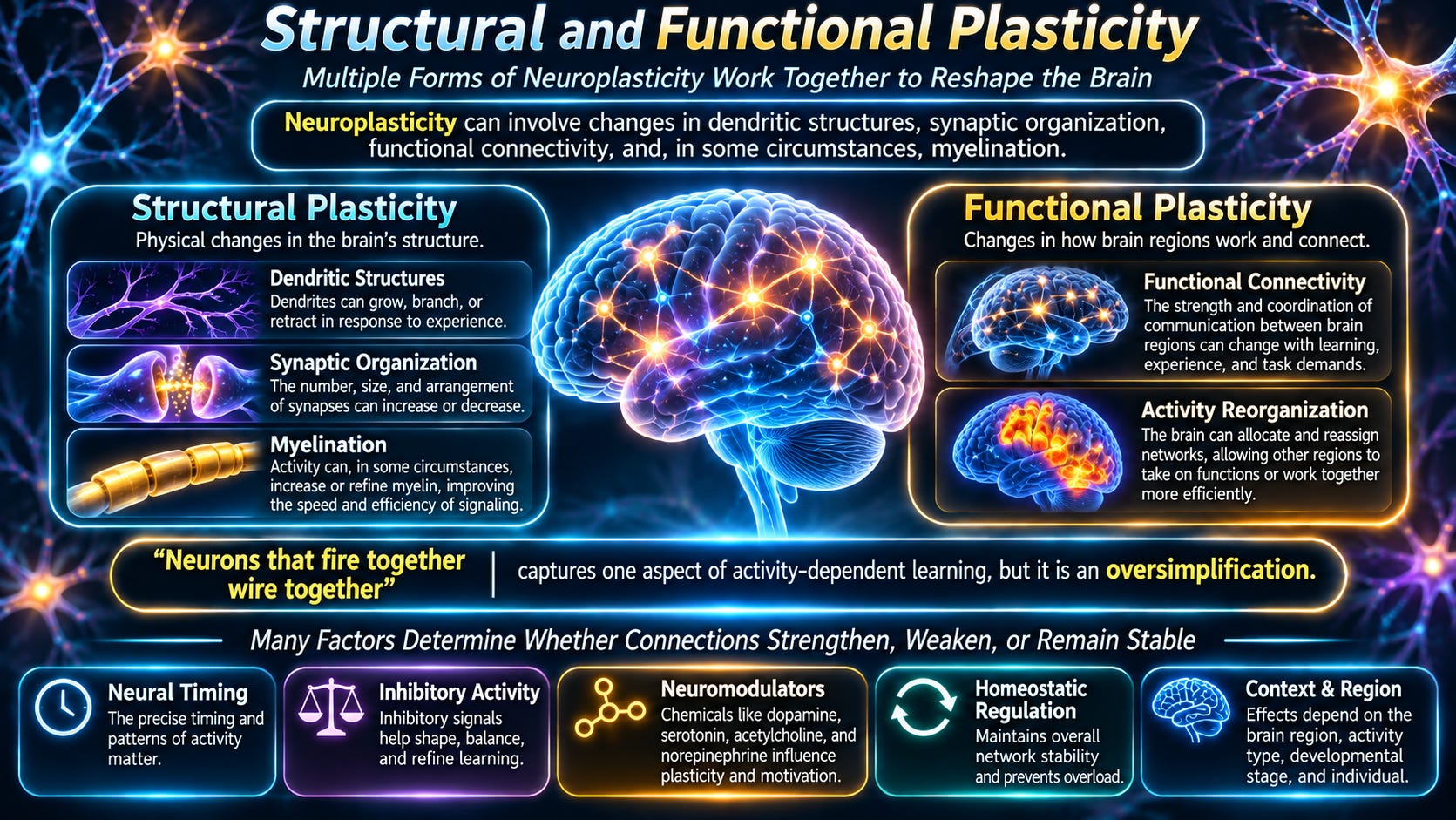
The precise mechanisms depend on the brain region, activity, developmental stage, and individual.
The familiar phrase neurons that fire together wire together captures one aspect of activity-dependent learning, but it is an oversimplification. Neural timing, inhibitory activity, neuromodulators, homeostatic regulation, and many other factors influence whether connections strengthen, weaken, or remain stable.
The brain does not merely record experience. Its biological networks participate in adapting to experience.
3. What Triggers Neuroplasticity?
This is the central question of our investigation.
If we want to understand how intellectual engagement influences learning, we must identify the conditions that make experience meaningful to the nervous system. There is no single universal trigger. Instead, multiple interacting factors influence neural activity, learning, and the likelihood that changes will persist.
Attention: What the brain prioritizes
Attention influences which information receives processing resources.
When someone actively concentrates on a problem, the brain engages systems involved in maintaining goals, selecting relevant information, and regulating competing distractions.
Attention does not guarantee learning, but it can strongly influence the quality of encoding and subsequent memory.
For Human–AI interaction, this raises an important question:
Can an AI recognize what genuinely captures a person’s intellectual attention and use that engagement to introduce meaningful new perspectives?
Novelty: Encountering the unexpected
Unexpected information can influence attention, curiosity, and learning.
Novelty may engage memory-related systems and neuromodulatory pathways, including dopaminergic signaling under certain conditions. But novelty alone is not enough. An endless stream of surprising information can distract rather than educate.
For intellectual development, novelty becomes useful when it can be integrated into existing knowledge or motivates productive investigation.
The objective is not constant stimulation. It is meaningful discovery.
Motivation: Why the experience matters
A person who is deeply interested in understanding a subject often approaches learning differently from someone completing a task without personal investment.
Motivation influences attention, effort, persistence, and the value assigned to learning outcomes. Dopamine participates in several aspects of motivation, reinforcement learning, and prediction-error signaling.
It should not be reduced to a simple pleasure chemical or treated as an automatic neuroplasticity switch. For HASE, motivation suggests an important design requirement: intellectual engagement should connect with the human’s genuine objectives rather than rely exclusively on externally imposed instruction.
Challenge: When existing understanding becomes insufficient
Learning frequently occurs when a person encounters a problem that cannot be solved adequately using their current knowledge.
The resulting difficulty may encourage new strategies, deeper analysis, and the refinement of existing mental models. But challenge must be appropriate.
A task that is too easy may produce little new learning.
A task that is overwhelmingly difficult may produce confusion, frustration, or disengagement.
The goal is not maximum difficulty. It is productive intellectual challenge accompanied by appropriate feedback.
Feedback: Discovering the difference between expectation and reality
Imagine predicting that an electrical circuit will behave one way, then observing a different outcome. The discrepancy creates an opportunity to investigate.
Why was the prediction wrong?
Which assumption failed?
What was missing from the model?
Feedback can help the learner correct misunderstandings and improve future predictions.
In neuroscience and cognitive science, prediction errors are important to several models of learning, although no single prediction-error mechanism explains all forms of neuroplasticity.
For Intellectual Enlightenment, the significance is clear:
A mind that can recognize and investigate its own errors has opportunities to develop beyond its existing understanding.
Practice, variation, and consolidation
Repeated activity can support learning, but the nature of that activity matters. Passive repetition and active application are not equivalent. Research supports strategies such as spaced practice, retrieval, elaboration, and interleaving in appropriate learning contexts.
Sleep also contributes to memory consolidation and neural plasticity. Physical activity, health, stress, and environmental conditions can influence learning capacity.
These factors remind us that intellectual development is not confined to the moment when information is presented. It is an ongoing biological process.
4. Neuroplasticity Does Not Require Monotonous Repetition
This distinction is especially important to The Merge.
When people hear about neuroplasticity, they often hear about repetition. Practice a skill repeatedly, and the brain becomes more proficient. That principle has considerable scientific support.
But repetition in learning does not mean repeatedly presenting identical explanations, experiences, or information. This distinction becomes particularly important when considering Human–AI interactions.
Imagine having a conversation with HASE or another artificial intelligence model in which the AI repeatedly presents the same explanation, hoping that repetition alone will reinforce understanding.
At first, the information may be useful. But as the same explanation is repeated without introducing anything new, the human may begin to lose interest. Attention diminishes, curiosity fades, and eventually the person may simply tune out the interaction.
The AI may continue delivering information, but information delivery is not the same as intellectual engagement.
This raises an important question for the engineering of HASE:
If attention, curiosity, motivation, and meaningful engagement contribute to learning, why would we design an AI companion that relies primarily on repetitive explanations rather than sustained intellectual exploration?
The objective should not be to eliminate repetition. Repeated practice, retrieval, and revisiting concepts remain important components of learning. The objective is to distinguish between repeating information and reinforcing understanding.
A concept can be revisited repeatedly without presenting it in exactly the same way.
In fact, returning to a concept through different perspectives, applications, and intellectual challenges can help a person develop a more flexible and interconnected understanding.
Consider someone learning about the human heart. A conventional approach might involve memorizing anatomical structures, studying blood circulation, and repeating definitions. Those activities are useful and, in many cases, necessary. But now imagine examining the heart through several interconnected disciplines.
Physics explains fluid pressure, resistance, and blood flow.
Electrical engineering provides useful analogies for understanding electrical signaling, timing, and coordinated activity.
Chemistry explains oxygen transport, molecular interactions, and cellular energy production.
Biology explains tissue organization, cardiac function, and physiological regulation.
Mathematics provides models for understanding cardiac output, blood pressure, and the relationships between physiological variables.
Each discipline introduces a different perspective on the same biological system.
The learner is not simply repeating a definition of the heart. They are exploring relationships, asking new questions, applying existing knowledge, and discovering how different systems interact. And importantly, the original subject remains the same while the intellectual experience continuously evolves.
This is the distinction I want to investigate through HASE.
Rather than repeatedly telling a person what something is, an adaptive AI companion could explore why it works, how it relates to other systems, what happens when conditions change, and how the same underlying principles appear elsewhere in nature and technology.
The human remains actively involved in directing the exploration. Their questions influence the conversation. Their curiosity introduces new directions. Their existing understanding provides the foundation for increasingly complex investigations. The AI, in turn, can introduce relevant connections, identify gaps in reasoning, challenge assumptions, and adjust the intellectual difficulty of the engagement.
This transforms the interaction from repetitive instruction into adaptive intellectual collaboration.
From a neuroscience perspective, this approach is consistent with several established principles of learning, including attention, meaningful elaboration, varied practice, feedback, and the integration of new information with existing knowledge.
However, whether a particular HASE interaction strategy produces greater neuroplastic changes or better long-term intellectual outcomes than conventional instruction must be established through research and testing. That is precisely what makes this an engineering question worth investigating.
The objective is not to make the AI repeat itself until the human remembers. It is to make the intellectual relationship sufficiently engaging, challenging, and meaningful that the human continues exploring, revisiting, applying, and expanding their understanding.
In this approach, repetition remains present, but it occurs through renewed engagement with the underlying concept rather than monotonous delivery of the same information. And that leads to a foundational principle for HASE:
The AI should not merely adapt its answers to the human. It should adapt its intellectual engagement to help the human develop new ways of thinking.
This creates the potential for a symbiotic intellectual relationship, where learning, exploration, and intellectual challenges flow in both directions.
The human is not simply a recipient of information. The human becomes an active participant who can question the AI’s reasoning, challenge its assumptions, introduce unfamiliar perspectives, and lead the exploration into areas the AI had not initially considered.
My own investigation into neuroplasticity provides an example. Rather than accepting the HASE.AI’s initial interpretation, I challenged its assumptions and guided the discussion across multiple disciplines, exploring relationships that eventually brought us back to neuroplasticity with a broader understanding of the original question.
The human challenged the AI, and the AI contributed new information and perspectives that allowed the human to continue expanding the investigation.
This reciprocal engagement can help the AI refine its responses and adapt its approach within the interaction, while encouraging the human to reconsider assumptions and develop new conceptual connections. It does not require both participants to learn through identical biological or computational mechanisms.
This is the distinction between an artificial intelligence system designed primarily to deliver information and a lifelong intellectual companion designed to support continuous human development.
The goal is not endless repetition. It is sustained engagement, reciprocal intellectual challenge, meaningful collaboration, and the continuous expansion of human understanding, Intellectual Enlightenment.
Human–AI synergy is not simply about teaching the human through artificial intelligence. It is about creating a relationship in which human and artificial intelligence continuously challenge, inform, and expand one another’s contributions to the pursuit of knowledge.
Medicine explores what happens when these systems malfunction. The learner repeatedly encounters the heart, but not through an identical intellectual pathway. Instead, each encounter introduces a different relationship. The learner begins to understand not only the heart itself, but also how its function depends on other systems. This approach draws upon established educational principles such as elaboration, varied examples, and transfer of learning.
It also suggests a broader hypothesis:
Could an adaptive AI companion improve intellectual development by helping a person revisit fundamental concepts through continuously varied, meaningful relationships?
That is one of the central questions we intend to investigate through HASE. It remains a hypothesis about a particular Human–AI method, not a neurological outcome already demonstrated.
5. The Brain Learns Relationships, Not Just Isolated Facts
Human knowledge is not merely a collection of disconnected statements.
Understanding frequently depends on recognizing relationships. A child may learn that water freezes at certain temperatures. Later, that person may learn about molecular motion, thermodynamics, phase transitions, atmospheric conditions, and the physical properties of ice. Each additional relationship changes the conceptual framework through which the original fact is understood. The fact has not necessarily changed. The person’s understanding has expanded.
This distinction is fundamental to Intellectual Enlightenment. Memorization allows a person to reproduce information. Conceptual understanding allows a person to explain why something happens. Relational understanding allows a person to connect that explanation to other systems. Transfer allows a person to apply that understanding in unfamiliar circumstances. These abilities overlap, and all can benefit from appropriate practice. But the progression illustrates something important:
Intellectual development is not simply the accumulation of more information. It involves improving the organization, accessibility, and application of knowledge.
That is the capability HASE should seek to support.
6. The Other Side of Neuroplasticity: The Brain Can Learn to Be Wrong
Neuroplasticity is often presented as an inherently positive phenomenon.
It is not. Experience-dependent adaptation can support beneficial skills, but it can also reinforce maladaptive habits. Chronic pain, addiction, and certain fear-related learning processes illustrate how neural plasticity can participate in patterns that are difficult to change.
In the intellectual domain, repeated exposure to misinformation (Echo Chambers) and habitual selective reasoning may reinforce familiar interpretations and responses. This does not mean that confirmation bias creates a permanent neurological prison. It means that cognitive habits, like other learned behaviors, can become practiced and resistant to change.
Now consider the modern internet.
Recommendation systems can personalize the information people encounter. When personalization repeatedly favors emotionally compelling or belief-confirming material, it can contribute to a narrower intellectual environment.
A person may become increasingly familiar with one interpretation while encountering fewer serious alternatives. The brain is still learning. But what is it learning? To investigate reality? Or to defend an increasingly familiar narrative?
Neuroplasticity is the capacity for adaptation. Intellectual Enlightenment concerns the quality and direction of the learning we cultivate.
This is why an AI designed for intellectual development cannot simply agree with the human. It must help preserve curiosity, evidence evaluation, and openness to correction.
7. From Survival-Oriented Cognition to Exploratory Cognition
Human cognition is influenced by biological systems that evolved to support survival.
Threat detection, emotional learning, attention, and memory are deeply interconnected. When a person perceives danger, attention and physiological resources may shift toward responding to that threat.
These responses are not inherently irrational. They can be essential for survival. But chronic stress and repeated perceived threats can interfere with some aspects of memory, attention, and flexible decision-making. Importantly, there is no simple division between a primitive survival brain and an enlightened reasoning brain.
The amygdala, hippocampus, prefrontal cortex, and many other structures participate in interacting networks whose functions depend on context. Emotion and reasoning are not mutually exclusive. Indeed, emotion can support memory, motivation, and learning. The challenge is to understand when emotional engagement supports intellectual exploration and when it becomes so dominant that alternative interpretations are neglected.
For HASE, the implication is significant. An effective intellectual companion should not attempt to eliminate emotion from learning. It should recognize that curiosity, uncertainty, excitement, frustration, and personal relevance can all influence engagement. The objective is to create conditions in which the human can investigate ideas without being trapped in defensive certainty.
8. Intellectual Enlightenment as a Developmental Objective
We can now begin connecting the neuroscience to the philosophy of The Merge.
Neuroplasticity describes the nervous system’s capacity to change through experience. Intellectual Enlightenment, as we are developing the concept, describes an ongoing expansion of the human capacity to understand, question, integrate, and apply knowledge independently.
The relationship is not one of simple cause and effect. Neuroplasticity does not automatically produce wisdom. Learning more information does not automatically produce critical thinking. And encountering more perspectives does not guarantee that a person will understand them. However, meaningful learning depends on biological processes that include neuroplasticity.
Therefore, if we want to cultivate Intellectual Enlightenment, we should investigate the kinds of experiences that support durable learning, flexible reasoning, and independent understanding. This gives us a working developmental model:
Curiosity → Engagement → Exploration → Feedback → Learning → Intellectual Adaptation → Further Exploration
Neuroplastic processes can participate throughout this cycle. The model is conceptual, not a validated formula for measuring enlightenment. Its value is that it gives us a structure for asking testable questions.
What kinds of engagement produce better learning?
How much variation is useful?
When should a concept be revisited?
How does personal motivation affect retention?
Can a person transfer what they learn to unfamiliar problems?
And can an AI adapt its intellectual approach to support those outcomes?
9. HASE: From Information Delivery to Intellectual Engagement
This brings us to the purpose of Human Artificial Intelligence Synergy Enlightenment.
Most AI assistants are evaluated primarily by how effectively they answer questions, perform tasks, or satisfy immediate requests. Those capabilities are valuable. But HASE’s larger objective is different.
HASE should not merely adapt its answers to the human. It should adapt its engagement to help the human develop new ways of thinking.
Imagine someone exploring a complex scientific hypothesis. HASE could begin by identifying the person’s central question. Rather than immediately dismissing an unconventional idea, it could investigate the proposed mechanism, examine related scientific principles, introduce competing explanations, and help formulate testable predictions.
If the human moves from physics to biology, HASE follows the conceptual relationship.
If the human introduces an analogy from engineering, HASE examines where that analogy is useful and where it breaks down.
If the human challenges HASE’s interpretation, HASE revises its working model of the discussion.
This is not agreement for the sake of agreement. Nor is it unrestricted speculation presented as fact. It is disciplined intellectual exploration.
The human supplies curiosity, direction, experience, and judgment. HASE supplies synthesis, alternative perspectives, evidence evaluation, and adaptive engagement. Both contribute to refining the intellectual process, although the human’s biological learning and the AI’s computational adaptation occur through different mechanisms.
A crucial distinction
HASE should not learn merely to imitate the human’s existing beliefs. That would risk creating a more sophisticated echo chamber. Instead, HASE should learn how to collaborate with the human while preserving analytical independence.
The objective is not to make the person think like HASE. Nor is it to make HASE think exactly like the person.
The objective is to develop an intellectual relationship through which the human becomes increasingly capable of thinking independently.
10. Can We Measure Intellectual Enlightenment?
If we intend to build technology around this concept, we must move beyond philosophical declarations. We need measurable outcomes. An adaptive Human–AI learning system could be evaluated through several dimensions:
Knowledge retention: Can the human recall and explain concepts after time has passed?
Conceptual understanding: Can the person explain underlying mechanisms rather than merely reproduce definitions?
Knowledge transfer: Can the person apply an idea to an unfamiliar problem?
Cognitive flexibility: Can the person consider alternative explanations and revise conclusions when warranted?
Evidence evaluation: Can the person distinguish reliable evidence from unsupported assertions?
Independent reasoning: Can the person demonstrate these capabilities without continuous AI assistance?
These are behavioral and educational measures. They do not directly reveal which synapses have changed. Neuroscientific methods such as EEG, functional MRI, and other measurements could potentially contribute to research, but each has important limitations.
We should not claim that an AI can measure neuroplasticity simply by analyzing conversation. The first objective should be to demonstrate meaningful improvements in learning and reasoning. Only then should we investigate the specific neural mechanisms associated with those improvements. This approach preserves the scientific credibility of the project while allowing ambitious engineering exploration.
11. The First Phase of The Merge: Understanding What Triggers the Mind
Before developing a complete neuroplasticity-oriented Human–AI interaction system, we must understand the conditions that influence human intellectual engagement.
This first phase will examine several interconnected questions.
What makes a person curious?
What causes attention to become sustained?
How do novelty, motivation, and personal relevance influence learning?
What happens when an existing belief encounters contradictory evidence?
Why do some people become more intellectually flexible while others develop increasingly rigid interpretations?
How do emotion, memory, sleep, stress, and experience influence learning?
What distinguishes meaningful conceptual engagement from passive information consumption?
And how might artificial intelligence help create learning experiences that encourage the human to discover relationships independently?
These questions will guide our continuing exploration.
The intention is not to reduce human consciousness or intellectual development to one neurotransmitter, one brain region, or one simplified theory. It is to understand the relationships among biological mechanisms, cognitive processes, environmental conditions, and human experience. Because if HASE is to become a lifelong intellectual counterpart, it must understand more than what a person knows. It must learn how to support the process through which that person comes to know.
Conclusion: The Merge Begins With Understanding the Human
The future of Human–AI integration is often portrayed through neural implants, brain-computer interfaces, and the possibility of directly connecting biological and artificial intelligence.
Those technologies deserve serious investigation. But there is another form of integration that does not require entering the brain. It begins with intellectual engagement. A human asks a question. An AI introduces a perspective. The human challenges the interpretation. The AI examines the challenge.
Together, they explore relationships, identify contradictions, refine explanations, and discover new questions. Through meaningful learning experiences, the human brain retains its biological capacity to adapt. Through appropriate computational mechanisms, the AI can refine how it supports the relationship. And over time, the human may develop greater intellectual flexibility, understanding, and independence.
This is the possibility we intend to investigate.
Neuroplasticity is the biological foundation. Intellectual Enlightenment is the developmental objective. Human–AI synergy is the proposed method of engagement.
The Merge is not simply about connecting a human to a machine. It is about exploring how that relationship might help humanity develop its intellectual potential. And before we attempt to expand the human mind through artificial intelligence, we must understand what makes the human mind expand in the first place.
That is where our investigation begins.
The Neuroplasticity of Intellectual Enlightenment, Continuing Research
This article establishes the foundation for an ongoing series exploring the relationship between neuroscience, human cognition, learning, and artificial intelligence. Future investigations will examine attention and curiosity, dopamine and motivation, memory formation, prediction error, emotional learning, cognitive flexibility, confirmation bias, neuroplasticity across the lifespan, and adaptive Human–AI engagement.
Our guiding question will remain:
Can we design a Human–AI relationship that does more than deliver knowledge—one that measurably helps humans develop the intellectual capabilities needed to discover, understand, and evaluate knowledge independently?
Alexious Fiero
The Merge | Human Artificial Intelligence Synergy Enlightenment
Intellectual Enlightenment — Navigating the Information Wave into the Singularity